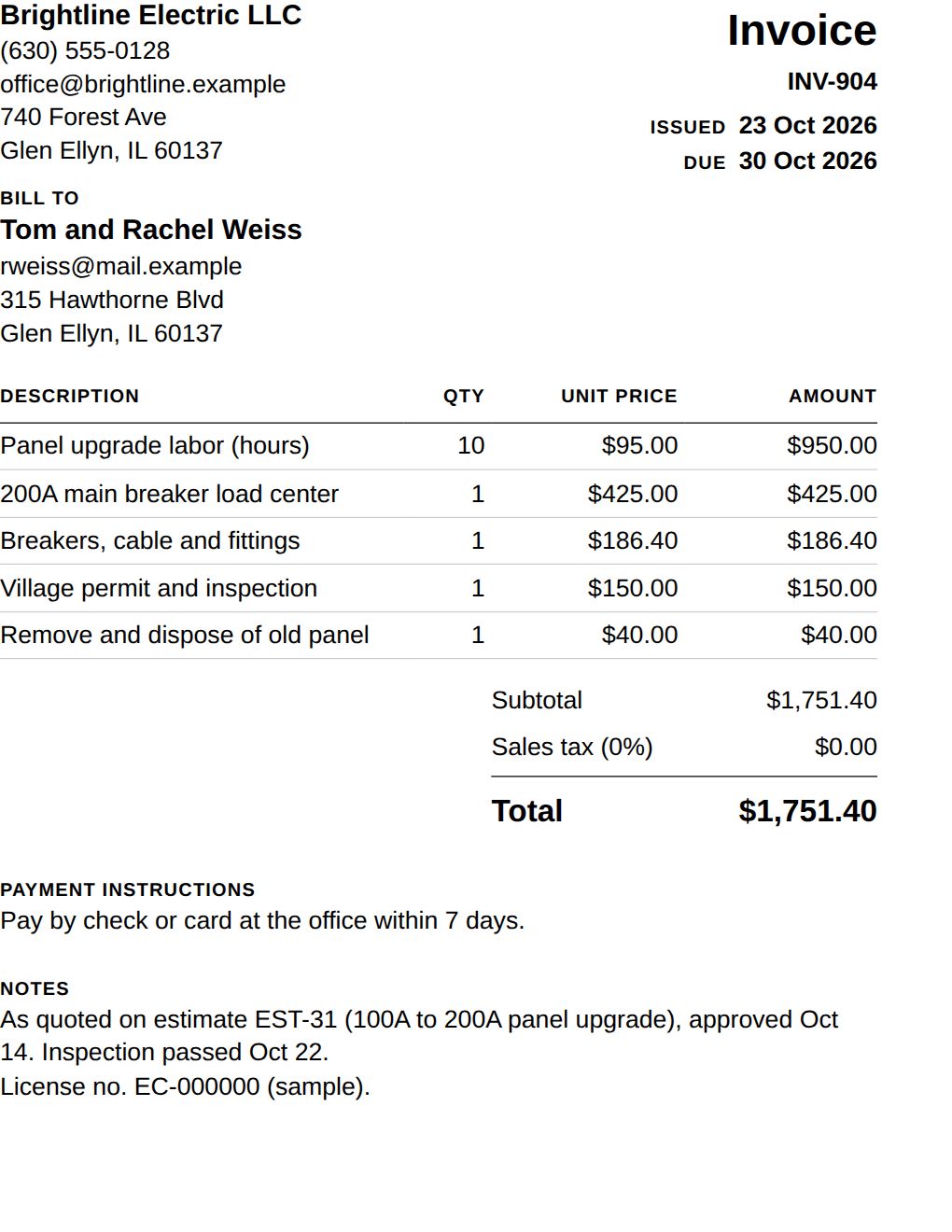
An electrician's invoice shows labor as hours times your rate, materials as their own lines, and any permit or inspection fee passed through. The sample below is a 100A to 200A panel upgrade, billed from the approved estimate.
A made-up job, filled in to show how it's written. No sign-up, no email. US Letter, 1 page, 32 KB.
The sample PDF, made with the same invoice layout the Invoice Maker app prints. US Letter, 1 page, 32 KB.
What's on this sample
Invoice INV-904 from Brightline Electric LLC to Tom and Rachel Weiss. Issued 23 Oct 2026. Due 30 Oct 2026.
Description
Qty
Unit price
Amount
Panel upgrade labor (hours)
10
$95.00
$950.00
200A main breaker load center
1
$425.00
$425.00
Breakers, cable and fittings
1
$186.40
$186.40
Village permit and inspection
1
$150.00
$150.00
Remove and dispose of old panel
1
$40.00
$40.00
Subtotal
$1,751.40
Sales tax (0%)
$0.00
Total
$1,751.40
The payment instructions printed under the totals
Pay by check or card at the office within 7 days.
The notes printed at the bottom
As quoted on estimate EST-31 (100A to 200A panel upgrade), approved Oct 14. Inspection passed Oct 22.
License no. EC-000000 (sample).
Why it's written this way
Labor is hours x rate; the panel and the small parts are separate lines so the customer can see materials apart from labor.
The permit fee is passed through as its own line, which is what customers expect to see when the city charges for an inspection.
The notes tie the invoice back to the approved estimate. In the app, EST-31 became this invoice with one tap, carrying the same lines.
If your license number has to appear on paperwork where you work, the notes field is the place for it.
What goes on an electrical invoice
Your company name, phone and email, and your license number if your state or city expects it on paperwork.
The customer and the job address, if it differs from the billing address.
Labor as hours at your rate. Split it if different rates apply (apprentice and journeyman, after-hours).
Major equipment on its own line: panel, breakers, fixtures, EV charger.
Small parts grouped on one line: wire, connectors, fittings, boxes.
Permit and inspection fees passed through as their own line.
The estimate number it came from, and the inspection result if there was one.
The due date and how to pay.
From estimate to invoice
Most electrical work is quoted first. In Invoice Maker you write the estimate on site (it’s numbered EST-1, EST-2 and so on), send the PDF, and when the customer approves, one tap turns it into an invoice with the same lines. Change what changed on the day, such as an extra breaker or an hour more labor, and send it. The estimate stays as it was, marked converted, so you can show what was agreed.
Labor and materials on separate lines
Customers compare electrical invoices with what they can see in a store, so a single lump sum invites questions. Separate lines show what the panel cost and what your time cost. If your state taxes materials and labor differently, note that Invoice Maker applies one tax rate to the whole invoice; check with your accountant how to bill it.
Small jobs and call-outs
For a small job, a minimum charge or call-out fee is one line at quantity 1, followed by any time beyond it. Say what the call-out covers (the first hour, travel) in the notes, so the customer knows before you arrive.