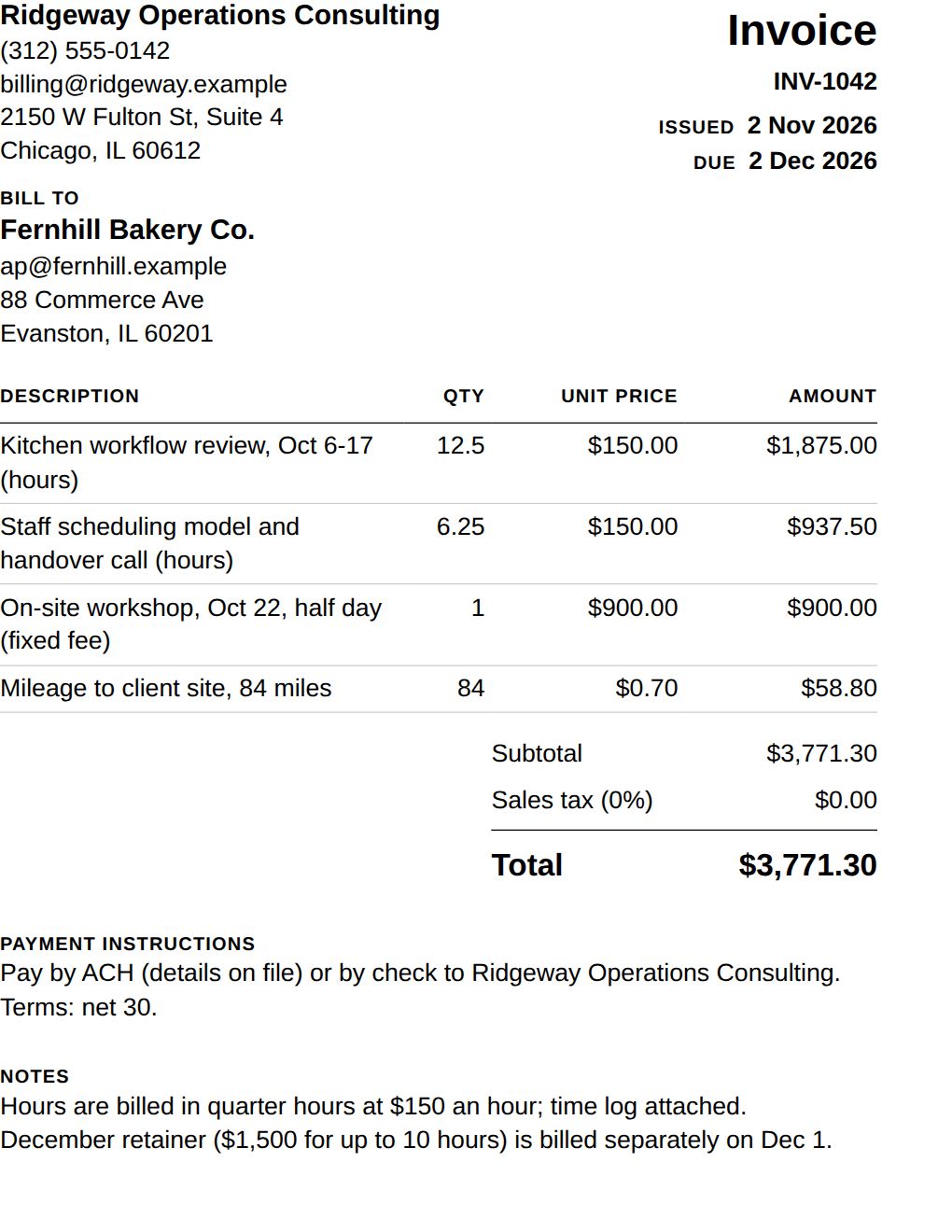
How to write an invoice for consulting services
Put these on every consulting invoice:
- Your business name, address and the email the client should reply to.
- The client’s company name, address and their accounts-payable email. Large clients often pay from a shared inbox, not your contact’s.
- An invoice number and the date you issue it. Numbers that count up (INV-1041, INV-1042) make it easy for both sides to match payments.
- One line per block of work: what you did and when, with the hours as the quantity and your hourly rate as the price.
- Fixed-fee work as one line at quantity 1, so it’s clear what was hourly and what wasn’t.
- Expenses you pass on at cost, each on its own line with the unit in the description (miles, nights, licenses).
- The due date and how to pay: bank transfer (ACH), check or card link, and the payment terms you agreed.
- The client’s reference, such as a purchase order (PO) number or project code, if they gave you one. Without it, some accounts teams can’t pay.
How do I invoice a client for hourly work?
Keep a time log by day, round each entry to the increment you agreed (the sample uses quarter hours), and bill the total as decimal hours. Say the increment in the notes and offer the log, so nobody has to ask.
Convert minutes to decimal hours before you type them in:
| Minutes | Decimal hours |
|---|---|
| 6 | 0.1 |
| 15 | 0.25 |
| 20 | 0.33 |
| 30 | 0.5 |
| 40 | 0.67 |
| 45 | 0.75 |
So 6 hours 15 minutes is 6.25, and 12 hours 30 minutes is 12.5. Invoice Maker takes quantities with up to three decimals and does the multiplication: 6.25 hours at $150 is $937.50.
Hourly or a fixed fee?
Hourly suits open-ended work: advice on call, reviews, anything where the scope can grow. A fixed fee suits a defined result: a workshop, a report, a set number of sessions. You can put both on one invoice, as the sample does with the half-day workshop. If a fixed-fee job runs over, agree the extra in writing before you bill it as hours.
Should consultants charge a retainer?
A retainer is money paid before the work, for a block of hours or for being available. Bill it on its own invoice before the period starts, with the hours it covers and what happens to unused time. Then bill the work itself as usual, or show the retainer as paid in the notes. Invoice Maker has no deposit or credit lines, so a retainer is always its own invoice there.
When should the client pay?
Whatever you agree, print the due date as a date, not only as a term. Business clients often ask for net 30, which means 30 days after the invoice date; the net 30 guide covers how to word it and what a late fee line looks like.