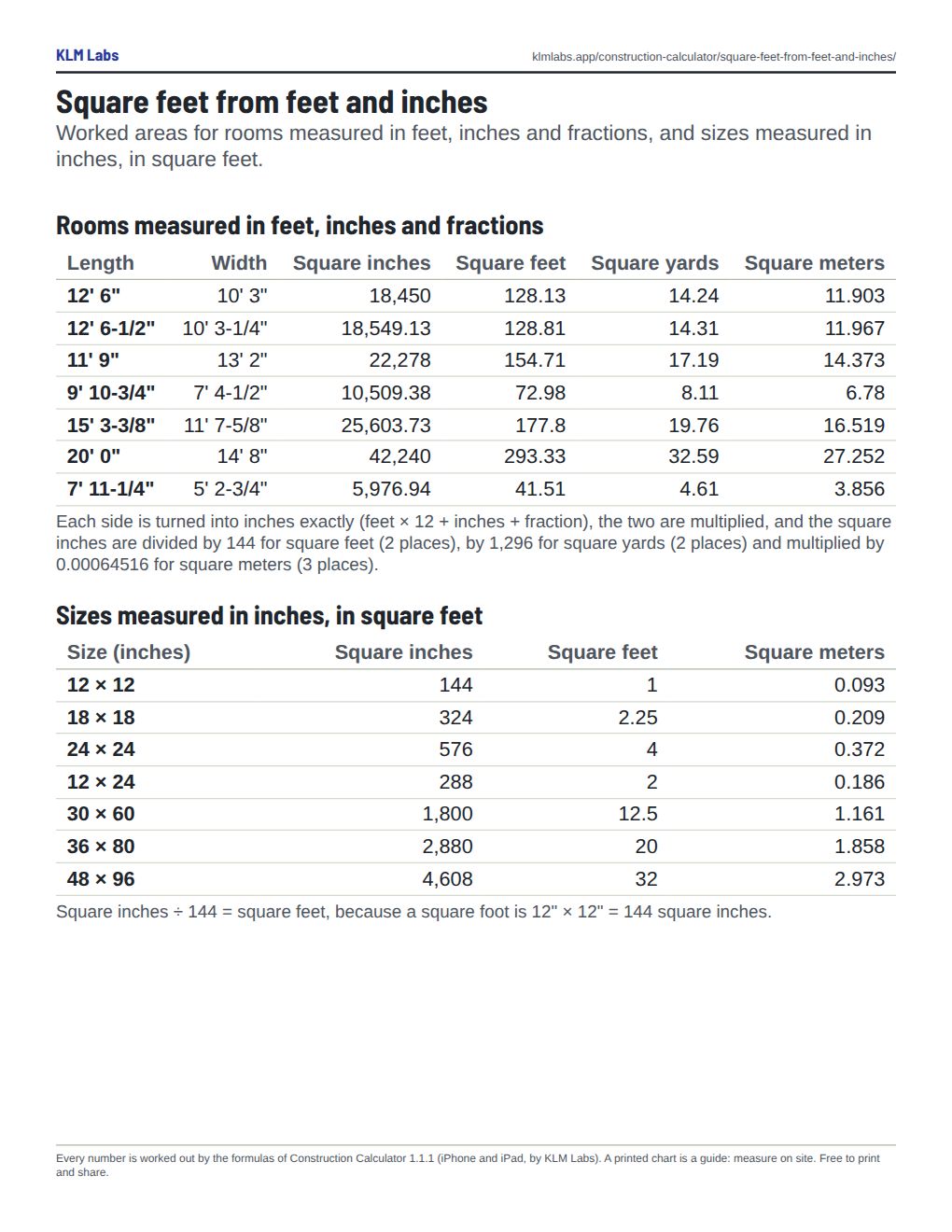
Why do you divide by 144 to get square footage?
A square foot is a square 12" on each side, so it holds 12 × 12 = 144 square inches. Dividing the square inches by 144 counts how many of those squares fit in the area. NIST’s Handbook 44 gives the same figure: 1 square foot = 144 square inches.
With fractions: 12' 6-1/2" × 10' 3-1/4"
- Turn each side into inches: 12' 6-1/2" is 12 × 12 + 6.5 = 150.5", and 10' 3-1/4" is 123.25".
- Multiply: 150.5 × 123.25 = 18,549.125 square inches.
- Divide by 144: 128.81 square feet.
Done as fractions all the way through, nothing is lost to rounding until the last step. The first table works seven rooms this way, from 7' 11-1/4" × 5' 2-3/4" to 20' × 14' 8".
Don’t read 12' 6" as 12.6 feet
A common slip is to type feet and inches as a decimal: 12' 6" is 12.5 feet, not 12.6, because 6" is half a foot. Multiplying 12.6 × 10.3 for the 12' 6" × 10' 3" room gives 129.78 square feet instead of 128.13. Either work in inches, or turn the inches into decimal feet first by dividing them by 12 (the fraction to decimal chart has a table for that).
Square yards and square meters
Divide square feet by 9 for square yards, since a square yard is 3' × 3' (1,296 square inches). For square meters, multiply square inches by 0.00064516, which is exact because an inch is exactly 0.0254 m. The 12' 6" × 10' 3" room is 14.24 square yards and 11.903 square meters.
Sizes given in inches
Tile, sheet goods and doors are sized in inches. A 12" × 24" tile covers 2 square feet, a 4' × 8' sheet (48" × 96") covers 32, and a 36" × 80" door opening is 20. The second table lists common sizes.
How the areas are rounded
Construction Calculator 1.1.1 turns each length into an exact fraction of an inch before it multiplies, so nothing is rounded until the answer: square feet to 2 places, with square yards and square meters under it.